Inside Skeleton Coast Uranium’s 5-EPL position in Namibia
May 1, 2026
Nathan Chutas, PhD, CPG CEO and Director Skeleton Coast Uranium Corp. May 1, 2026
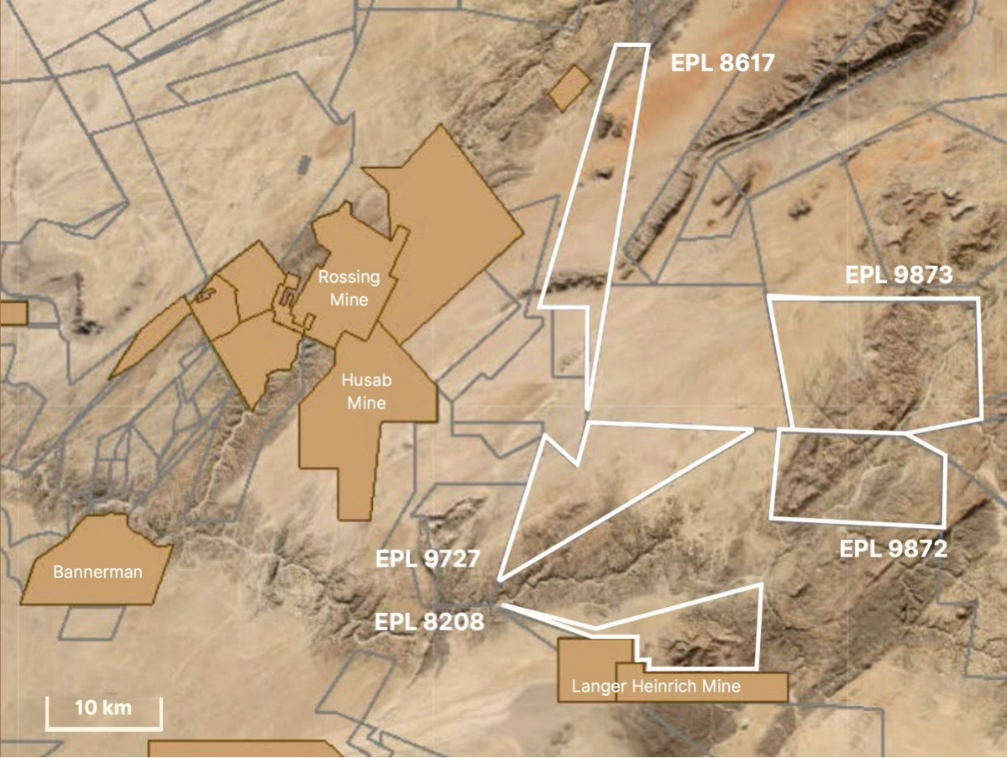
Skeleton Coast’s land position is simple to describe and hard to ignore: five EPLs covering 610 square kilometres in the heart of Namibia’s uranium belt.
You can read the technical details in the presentation. What I want to do here is give you the plain-speaking version — what we optioned, why we wanted it, and why I think it matters.
We have optioned, not one isolated target, but five exclusive prospecting licences, or EPLs, in Namibia’s Erongo Region, one of the best-known uranium districts in the world. The region is home to some of the world’s largest uranium mines (Rössing, Husab and Langer Heinrich), established infrastructure, policy and production history.
Of course, being close to major mines does not guarantee anything, but it does improve the odds that you are asking the right geological questions in the right jurisdiction for development.
It gives context to the work.
And our five-EPL structure broadens our position, improving those odds even further.
EPL 8617 covers 10,492 hectares and potentially shares the same geology and structure as Rössing (one of the world’s longest-running open-pit uranium mines). Then you have EPL 9727 (12,081 hectares) about 15 kilometres east of Husab (the world’s third-largest uranium mine in 2024) and EPL 8208 (7,841 hectares), 25 kilometres southeast of Rössing and adjacent to Langer Heinrich.
If you build a company around one licence, one anomaly and one idea, you are maybe betting the whole story on a single outcome. Sometimes that works, but many times, it does not. Our projects gives us, not just scale, but useful scale with optionality in a real district. A pipeline, if you will, not just a headline, where we can compare targets, rank them, allocate capital and effort where the data is strongest, and keep building the picture as the work advances.
Each licence gives us a different angle into the district. Recent processing and interpretation of regional airborne radiometric data undertaken by Namibia Ministry of Industry, Mines and Energy, identified significant uranium anomalies on all five EPLs. The licenses give us district scale and room to build out a pipeline rather than hang everything on one target. The mix is important in providing resilience to the project.
The 610 square kilometres matter for the same reason. It is enough ground to matter, but more importantly it is enough ground in a proven belt to give us optionality. We are not boxed into one idea, but can instead think across the district, looking for patterns.
And this is where the mine corridor really matters.
Rössing has been operating since the 1970s; Husab is one of the largest uranium mines in the world; Langer Heinrich is back in production. When you are working in the same wider uranium belt as operations like these mines, you are not speculating on whether the region matters. It already does. Instead, the job is to work out where the next meaningful targets might be.
That is how I look at our ground.
I do not see five licences as five separate exploration points. I see them as one position in one of the few uranium districts in the world that already has mine scale, operating history and real strategic importance.
There is another part of this that matters as well: these projects are held with local Namibian partners. If you are going to build in-country, build properly, then it’s important to work with people who know the jurisdiction, understand the landscape and are part of the mining ecosystem. For me, that is not a side note. It is part of building a serious company in for the long-term.
Share
Leadership Insights
From historical records to 42 ranked uranium targets
October 14, 2026
We have completed the digitisation of the historical exploration data across all five Namibian licences on schedule, bringing approximately 140 historical sheets into one digital mapping system.
Earning the Right to Drill: what our new NI 43-101 reports mean
August 11, 2026
On August 4, we announced the filing of independent NI 43-101 technical reports for EPL 8208, EPL 9727 and EPL 8617, prepared by Christopher J. Male, Senior Geologist at Practara.
A tale of two uranium models: EPL 9727 and EPL 8208
July 2, 2026
Being close to three of the world's major uranium mines matters, but EPLs 9727 and 8208 give us something else as well: they give us two different opportunities to find uranium.
From historical records to 42 ranked uranium targets
October 14, 2026
We have completed the digitisation of the historical exploration data across all five Namibian licences on schedule, bringing approximately 140 historical sheets into one digital mapping system.
Earning the Right to Drill: what our new NI 43-101 reports mean
August 11, 2026
On August 4, we announced the filing of independent NI 43-101 technical reports for EPL 8208, EPL 9727 and EPL 8617, prepared by Christopher J. Male, Senior Geologist at Practara.
A tale of two uranium models: EPL 9727 and EPL 8208
July 2, 2026
Being close to three of the world's major uranium mines matters, but EPLs 9727 and 8208 give us something else as well: they give us two different opportunities to find uranium.